As global economies strive towards achieving carbon neutrality, fighting climate change and accessing more efficient clean energy, green hydrogen is poised to play a leading role in the upcoming energy transition. Green hydrogen has the potential to become a sustainable fuel to replace fossil fuels in sectors that are difficult to decarbonize. It has a critical role to play in helping the world reach net zero emissions and take steps towards achieving sustainability.
WHAT IS HYDROGEN?
There are total 118 elements in the periodic table. Hydrogen is the first element of the periodic table as its atomic number is one. Hydrogen is the simplest element and the most abundant element in the universe. It is 14 times lighter than the air. Under normal circumstances, such as at room temperature and under normal pressure conditions, hydrogen is a gas. When hydrogen is cooled to -253°C it liquifies. In simple terms, Hydrogen is a colorless, odorless, tasteless, flammable gaseous substance and has the lowest density of all gases.
DIFFERENT TYPES OF HYDROGEN
Producing hydrogen takes energy because hydrogen atoms don’t exist on their own — they are almost always stuck to another atom, often another element. Pure hydrogen has 2.4 times the energy as an equivalent amount of natural gas. When you burn hydrogen, you generate energy in the form of heat, and the only by-product is water, making it a clean source of energy. However, it requires energy to make the hydrogen in the first place.
Hydrogen can be made from natural gas, coal, or biomass, but these energy sources have associated greenhouse gas emissions. Blue hydrogen can be generated by utilizing natural gas but with the incorporation of carbon capture and storage technologies to mitigate the associated greenhouse gas emissions. But with the upcoming transition in technologies hydrogen can also be made using an electrolysis process to split water molecules into oxygen and hydrogen.
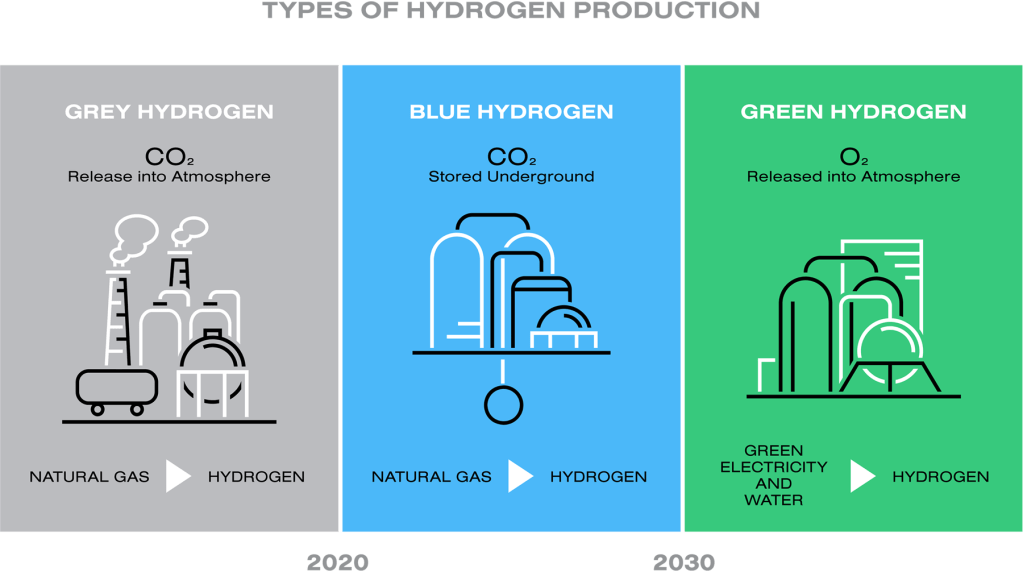
The production hydrogen is color-coded based on the source and production process and these colors include such as:
Black and brown – use black coal or lignite (brown coal) in the hydrogen-making process
Pink – generated through electrolysis powered by nuclear energy
Turquoise – uses a process called methane pyrolysis to produce hydrogen and solid carbon
Yellow – new phrase for hydrogen made through electrolysis using solar power.
White – naturally occurring, geological hydrogen found in underground deposits
Hydrogen is an invisible gas. So, despite their colorful descriptions, there is no visible difference between the different types of hydrogen.
WHAT IS GREEN HYDROGEN?
Green hydrogen is made by using clean electricity from renewable energy sources, such as solar or wind power, to electrolyse water. Electrolysers use an electrochemical reaction to split water (H2O) into its components of hydrogen (H2) and oxygen (O2), emitting zero-carbon dioxide in the process. Hence it can be used as a fuel in the presence of oxygen and is a green source of energy as it only releases water combustion as a byproduct.
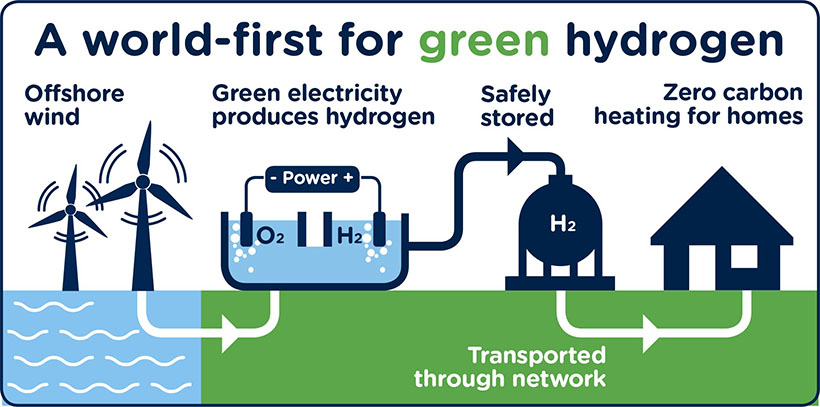
The term “green hydrogen” refers to hydrogen produced without generating harmful emissions, in other words, sustainable hydrogen. This fuel is increasingly viewed as the essential energy carrier for achieving worldwide decarbonization efforts.
ADVANTAGES OF GREEN HYDROGEN
Green hydrogen has been lined up to be one of the key components of the unavoidable energy transition. The main economies in the world have to lead to achieve carbon neutrality and stop climate change. The advantages of this clean fuel speak for themselves in terms of the significance of the new energy system:
– Clean energy: the only waste/end product it emits is water.
– 100% renewable: produced using natural resources, such as wind and solar energy.
– Storable: can be compressed and stored in ad hoc tanks for long periods.
– Transportable: it is a very light element and can be easily handled in compressed form.
Where can it be used?
In the push towards achieving net-zero emissions by 2050, multiple national and regional policies are aligning, with hydrogen being a crucial component of the solution alongside renewable fuels and electrification. There is currently a growing interest in the production of green hydrogen technologies due to the increasing number of sectors that can benefit from its use. The major sectors where green hydrogen can be used are as follows:
– Sustainable Mobility
– Steel Manufacturing
– Heavy Transport
– Energy Storage
– Industry
– Domestic Use
Hydrogen has a strong potential to serve as a foundation for sustainable aviation fuel, particularly in the context of long-distance freight, aviation, and shipping. Unlike batteries, which are limited by range and weight restrictions, many experts see promise in using hydrogen in combination with carbon from captured CO2 emissions to create an e-SAF (Sustainable Aviation Fuel). This fuel can easily integrate into existing aircraft designs as it is chemically similar to conventional aviation fuel.
What are the challenges?
1. Technology: Electrolysis only produces around 5% of hydrogen worldwide. The current production is based mainly on natural gas and coal, which together represent 95%.
2. Cost: Green hydrogen is more expensive to produce than grey hydrogen. However, the fall in the price of renewable energies has opened a new window of opportunity for its cost to become increasingly competitive.
3. Electricity: Creating green hydrogen needs a huge amount of electricity, which means a mind-blowing increase in the amount of wind and solar power to meet global targets.
4. Safety issues: Hydrogen is a highly volatile and flammable element; therefore, extensive safety measures are required to prevent leakage and explosions.
Global Market for Green Hydrogen
Hydrogen is the smallest molecule in the universe, but hydrogen has immense potential as a clean fuel for the global energy transition. The number of countries with polices that directly support investment in hydrogen technologies is increasing, along with the number of sectors they target.

According to Strategy& report, countries such as Brazil, China, India, and the U.S. meet the criteria for large-scale and relatively low-cost green hydrogen production. However, their export potential is limited as domestic demand will absorb most of their own production. By contrast, Argentina, Australia, Canada, and Saudi Arabia can export most of their green hydrogen production, because electricity and gas are cheaper than hydrogen for these countries’ domestic energy requirements.
The shift towards low-carbon energy sources in existing value chains will create new market dynamics and dependencies, as well as geopolitical trends. The geopolitical trends can impact international relations in the coming decades, as countries vie for dominance in industry, markets, and opportunities for job growth. Therefore, taking steps towards green hydrogen is necessary considering all the socio-economic and environmental factors. This presents a global opportunity to implement and conduct business with a versatile new source of energy.
“I believe that water will one day be employed as fuel, that hydrogen and oxygen which constitute it, used singly or together, will furnish an inexhaustible source of heat and light, of an intensity of which coal is not capable.”
– Jules Verne
Vedant Kale is an independent strategist, writer, and founder of Vedant Insights. He writes at the intersection of geopolitics, economics, and technology.
Follow on LinkedIn | Visit csuitemodels.com | Subscribe to Vedant Insights
 VEDANT INSIGHTS
Use full for my project 👍
LikeLiked by 1 person
Thank you, Aditya !!
LikeLike
Unless we get RTC power at 2 RS or better 1 , gh is unviable against competing grey energy.
LikeLike
Agreed!
LikeLike