In the era of AI, where technology is advancing faster than ever through smarter algorithms, autonomous systems, and powerful tools, it’s easy to assume machines will soon outthink us. But AI is set to replace commonality, not originality. To stay relevant, we must think deeper, be creative, stay inventive, and always find a new angle in. Today, even the world’s top CEOs can’t confidently predict what future jobs will look like once AI takes over most traditional roles. This uncertainty signals a deeper shift—education, careers, businesses, and job roles are being redefined in real time. In this evolving landscape, those who think differently, adapt quickly, and build strong mental models will not only stay relevant but lead the way forward.
What are Mental Models?
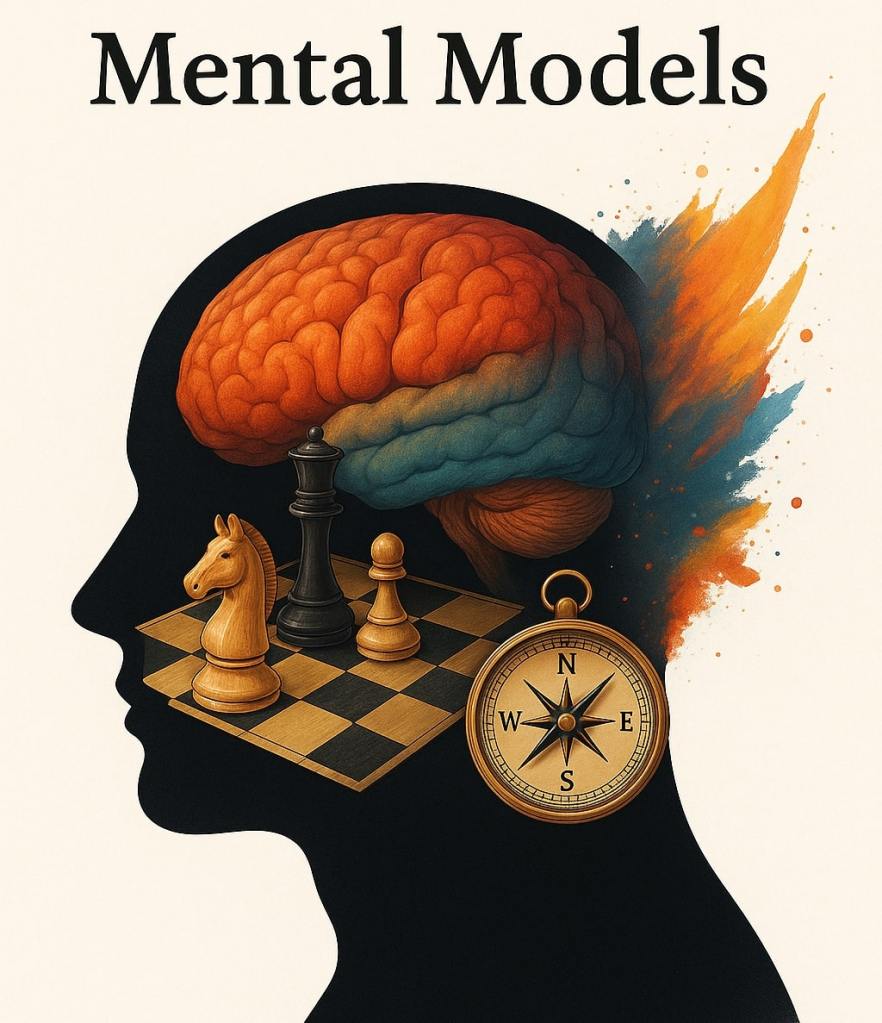
Mental models are frameworks of principles and thought patterns developed through experience and knowledge. They help us understand the world, interpret situations, and make better decisions.
These models include tools like first-principle thinking, critical thinking, emotional intelligence, unit economics, inversion, and structured decision making. Everyone can develop their own unique set of mental models, and there’s no universal list that applies to all.
Masters of Mental Models
Warren Buffett and Charlie Munger never built any technology. Steve Jobs never wrote a single line of code for Apple. Yet, all of them have been among the best at what they do, not because of what they built but because of how they thought. What they all have in common is a mastery of strong mental models. Naval Ravikant is a modern embodiment of this principle, someone who built immense value through clarity of thought, not conventional output.
If you listen to their interviews, you’ll notice they avoid fancy terms or jargon like many industry elites. Instead, they speak with simplicity and clarity, making complex ideas accessible and actionable. They focus on a few core principles that drive everything else. One of them: If you don’t understand a business, don’t enter it. Don’t commit to what you don’t truly understand, chasing mediocrity.
Foundation of Mental Models
People with strong mental models understand the unit value of time. They focus on tangible outcomes over perceived value, prioritizing what truly moves the needle. Instead of spreading themselves thin with countless tasks they aren’t good at, they double down on what they enjoy and excel at.
They tend to think more rationally and with a more neutral perspective—approaching problems with clarity, questioning assumptions, and relying on fundamentals over emotions or hype. As a result, they make better decisions in both professional and personal life. Whether it is choosing a career path, evaluating a business opportunity, or navigating relationships, mental models provide structure, reduce bias, and simplify complex choices.
The Golden Circle

Popularized by Simon Sinek, the Golden Circle is a powerful framework understood by those with strong mental models. Starting with Why creates clarity and motivation. It aligns actions with values and keeps efforts focused on what truly matters.
When your Why is clear and your How is well-structured, the What often takes care of itself.
The Need for Mental Models is Now More Than Ever.
People who have developed strong mental models have thrived across every technology, era, and generation. Creating mental models is like playing chess — it involves recognizing patterns, strategic thinking, problem solving, and making thoughtful decisions. Just as a skilled chess player anticipates moves ahead of their opponent, those with well-honed mental models navigate complex situations ahead of time with clarity and confidence.
In a world of rapid change, mental models aren’t just useful — they are indispensable. They empower you to think deeper, act smarter, and shape the future rather than be shaped by it. Mental models are the edge humans still hold, and they will be the compass guiding us through uncertainty.
“Every battle is won in the mind before it is fought on the battlefield.”
— Vedant Kale
 VEDANT INSIGHTS