For more than a century, the structure of industries has been shaped by two strategic forces: vertical integration and horizontal integration. Both strategies pursued the same objective: control over supply chains, competitors, and markets. From oil companies controlling refineries and distribution networks to tech giants acquiring competitors and locking in markets, the strategy was always the same: own the chain, own the outcome. Artificial intelligence may now be rewriting that playbook. The next phase of integration will not be driven by factories or acquisitions, but by intelligence systems.
Vertical Integration
Vertical integration has traditionally meant controlling multiple stages of a value chain, from production and logistics to distribution and customer access. Instead of relying on external suppliers, companies owned the entire process, controlling cost, quality, and margins. In the AI era, ownership is no longer the requirement. Intelligence is.
In technology, a product that once required a frontend developer, a backend engineer, a designer, and a deployment team can today be built by a single developer using tools like Cursor, Emergent, and Claude. The infrastructure no longer needs to be physical. It needs to be smart.
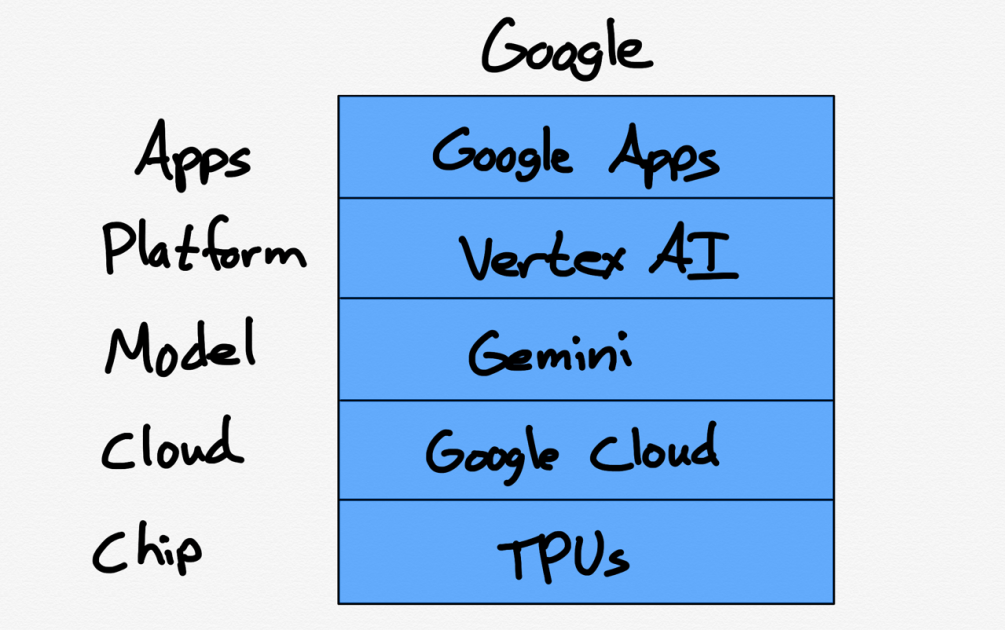
Google is the clearest example of what AI-driven vertical integration looks like at scale. The company has built an AI stack that runs from the ground up. Custom chips (TPUs) power the computing infrastructure, global data centers train the models, foundation models like Gemini deliver the intelligence, and cloud platforms deploy it all. Each layer feeds the next. By owning this entire stack, Google is not just competing in AI. It is positioning itself as the infrastructure on which much of the AI economy will run. Gemini is the proof. It is trained on Google’s own computing infrastructure, integrated across search, productivity tools, and cloud services, and deployed at a scale that no external provider can replicate. From computing power to intelligence systems to consumer and enterprise applications, the entire value chain sits within one ecosystem.
Horizontal Integration
Instead of competing for market share, acquire the competitor and dominate the market. Facebook bought Instagram, acquired WhatsApp, and locked users into an ecosystem they could not easily leave. Reliance, through ventures like Jio, expanded into internet services, entertainment, daily household essentials, clothing, finance, and fuel, becoming a one-stop ecosystem for the everyday needs of an entire nation. This is horizontal integration. More users, more markets, less competition.
When ChatGPT, Gemini, and Perplexity launched, they did one thing: answer questions. As their capabilities expanded into coding, image generation, research, and automation, these platforms began absorbing functions that once belonged to entirely separate software industries.
For decades, Bloomberg Terminal was the undisputed gold standard of financial intelligence. A single subscription costs nearly $32,000 per year, yet banks, hedge funds, and analysts paid without hesitation because there was no alternative. It owned the market. Bloomberg built a $6 billion business on one premise: access to financial intelligence was scarce, and scarcity commanded a price. AI is beginning to challenge that premise. ChatGPT, Gemini, and Perplexity did not enter the financial data industry through acquisitions or partnerships. They expanded their capabilities until financial analysis became just another thing they could do. A tool that costs $32,000 a year is now being replicated by a $20 monthly subscription. Bloomberg was not disrupted by a competitor. It was absorbed by an expanding intelligence system. AI did not acquire Bloomberg. It simply expanded into its market.
No company illustrates AI-driven horizontal integration more powerfully than Google. Its foundation was search. But as Gemini grew more capable, the same intelligence began expanding across entirely new industries. Google Health is using AI to detect diseases earlier than human doctors. Waymo is redefining transportation. Google Workspace is embedding AI across every tool businesses run on. The same intelligence, trained on Google’s own infrastructure, is now present in healthcare, transportation, enterprise software, education and many other industries. Google does not need to buy its way into new markets. It simply expands its intelligence until those markets become part of its ecosystem.
The Convergence
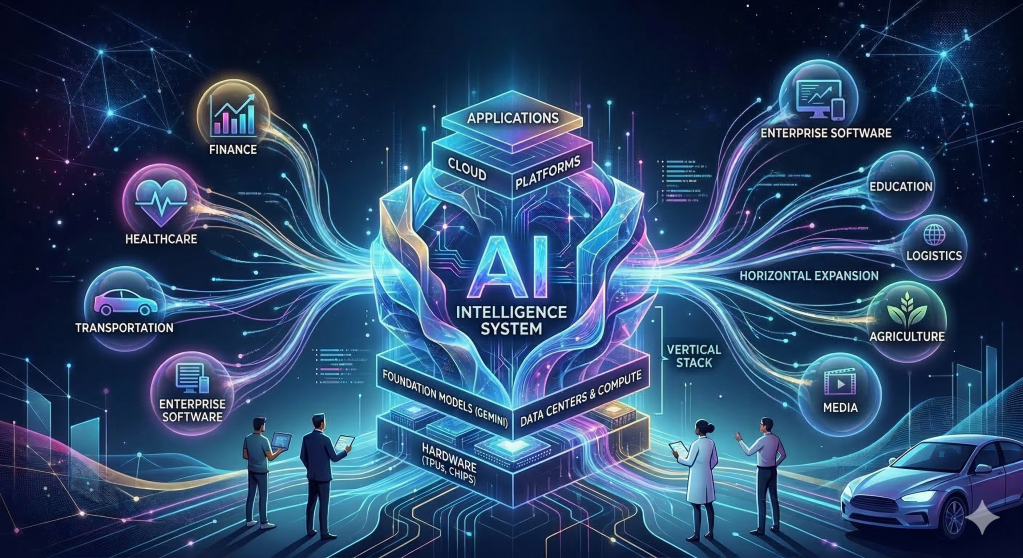
Companies have always tried to integrate vertically and horizontally at the same time. But it took decades and billions of dollars to do it. AI does it with every update. A company that builds and owns the AI stack from hardware to model to application is vertically integrated. A company that deploys that same stack across healthcare, finance, education, and logistics is horizontally integrated. In the AI era, the same asset does both simultaneously. Google is the proof. It owns the stack and expands across every industry it touches. This is what makes the current moment unlike anything in industrial history. The moat is no longer a factory or a market position. It is an intelligence system that gets stronger with every user, every query, and every new industry it touches.
Conclusion
AI is still at a very early stage. Yet with every update, it is absorbing new markets, replacing old tools, and redrawing the boundaries of entire industries. This is no longer limited to factories and tech. Hollywood is watching AI generate scripts, voices, and entire visual productions. Farmers are using AI to monitor crops, predict yields, and automate decisions that once required years of experience. Financial analysts, lawyers, designers, and educators are all facing the same reality. One model update from ChatGPT, Gemini, or any other platform can make a business model that took years to build obsolete overnight.
But the same force is also the biggest opportunity. A solo developer can now build what once required a team. A startup can now compete with infrastructure that once belonged only to giants. The opportunity is real. So is the threat. No business is too big to be disrupted and no market is too defended to be entered. In the AI era, legacy means nothing. Adaptability means everything. The only businesses that will thrive are the ones that treat every AI update not as a headline but as a strategic signal. The next chapter of integration is being written. The question is whether your business is writing it or being written out of it.
“AI does not need to acquire or challenge your business.
It simply expands until it includes it.”
— Vedant Kale
 VEDANT INSIGHTS