India’s traditional Dahi Handi festival offers a useful framework for understanding today’s AI economy. In the festival, a human pyramid relies on a broad, stable foundation to support a single climber at the top.

Today, that balance is shifting. While infrastructure providers continue to benefit from sustained investment, AI software companies face growing pressure to justify their valuations amid rising compute costs and uncertain paths to profitability. Wall Street is increasingly questioning whether the companies at the peak can sustain both their valuations and their economics.
The Mechanics of the Pyramid
A Dahi Handi pyramid distributes weight and risk in a predictable way. The base carries the greatest load and provides stability for the entire structure. Each successive layer carries less weight but absorbs greater strain as load is transferred downward. The climber at the top receives the recognition, but its success depends entirely on the supporting layers beneath it. Instability rarely begins at the base. It starts higher up, where small imbalances can destabilise the entire structure.
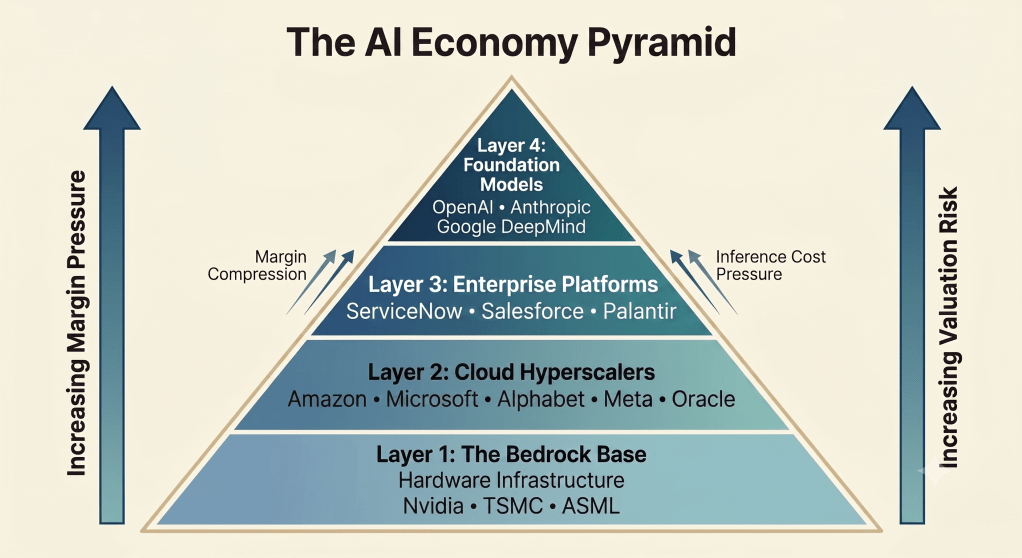
The same structure is visible in the AI economy: hardware providers form the foundation, cloud hyperscalers provide the infrastructure layer, enterprise platforms enable adoption, and foundation model developers occupy the highest-value layer. However, value creation and economic pressure are not distributed evenly across the stack.
1. The Bedrock Base: Hardware Captures the First Dollar
The AI investment cycle begins with hardware. Companies such as Nvidia, TSMC, and ASML generate revenue before AI models serve a single prompt, supplying the GPUs, advanced chips, and semiconductor equipment required to build AI infrastructure. As hyperscalers accelerate data centre investment, demand for these components remains strong.
Hardware suppliers are paid upfront as infrastructure is deployed. Even if some AI applications fail to meet expectations, the underlying chips and data centres have already been purchased, making hardware the most resilient part of the AI value chain.
2. The Straining Center: Hyperscalers Bear the Capital Burden
Cloud hyperscalers, including Amazon, Microsoft, Alphabet, Meta, and Oracle, are investing at an unprecedented pace to expand AI infrastructure. Collectively, they are expected to invest US$660 billion to US$690 billion on AI-related data centres and supporting infrastructure. Failing to build sufficient capacity today risks losing tomorrow’s AI market.
The challenge is not demand, but timing. Infrastructure spending is rising far faster than near-term monetisation, forcing investors to balance long-term positioning with near-term returns. This tension was evident during Alphabet’s Q2 2026 earnings call. Despite reporting strong financial results, the company raised its AI capital expenditure guidance, heightening concerns that infrastructure investment is outpacing near-term monetisation.

3. The Enterprise Layer: Selling Productivity, Not Compute
Unlike frontier AI companies, enterprise software providers such as ServiceNow and IBM embed AI into existing business workflows rather than selling compute-intensive models directly. Their subscription-based business models make them less exposed to the economics of model inference.
However, they remain dependent on enterprise technology spending. The Q2 2026 earnings cycle highlighted this dynamic, with IBM missing revenue estimates and trimming its full-year outlook as enterprise customers shifted technology budgets from traditional software and infrastructure towards AI infrastructure and compute. While enterprise platforms avoid the direct margin pressure of model inference, they remain exposed to budget reallocation as AI captures a growing share of enterprise technology investment.
4. The Shaky Peak: The Software Margin Collapse
AI model developers incur a meaningful cost every time a customer uses their product. Every prompt requires compute, making inference an ongoing operating expense rather than a one-time infrastructure investment. Whereas traditional SaaS benefits from expanding margins as it scales, AI models become more expensive to serve as usage grows.
This represents a fundamental departure from the traditional SaaS model, where additional users contribute little incremental cost and gross margins often exceed 80%. For companies such as OpenAI and Anthropic, sustaining multi-billion-dollar valuations increasingly depends not only on building the most capable models, but on proving they can scale profitably. As investors shift their focus from growth to unit economics, technical leadership alone is no longer sufficient.
5. The Consumer Squeeze: The AI Double Tax
The economics of AI model providers are increasingly being passed on to consumers through what can be described as the AI double tax.
The first is hardware. As demand for AI infrastructure drives up the cost of memory and storage, manufacturers are introducing more expensive AI-ready devices. Apple, for example, has increased prices across select product lines, citing higher memory component costs driven by AI-related demand.

The second is software. Even after paying a premium for devices with higher RAM and storage, the most advanced AI models still run primarily in the cloud. Accessing frontier capabilities requires recurring subscriptions such as ChatGPT Plus, Claude Pro and Microsoft Copilot Pro. As subscription fatigue grows, this dual cost structure raises an important question: how much are consumers ultimately willing to pay for AI?
6. The Market Reality Check
The changing economics of AI are already reshaping how companies price, deploy, and consume the technology. As inference costs remain high, businesses are moving away from traditional flat-rate software models towards pricing structures that more closely reflect underlying compute usage.
This shift is already visible across the industry. Anthropic has introduced usage-based pricing for enterprise customers, while autonomous AI agents are proving significantly more expensive to operate than conventional chatbots because they require substantially more compute. The pressure extends beyond AI developers. Uber, for example, introduced a $1,500 monthly spending cap per developer seat on AI coding tools after engineering teams exhausted the company’s annual AI tooling budget in just four months. This illustrates how rapidly AI costs can escalate as enterprise adoption scales.
Several high-profile AI companies have delayed public listings as investors place greater emphasis on sustainable unit economics than on rapid revenue growth alone. Together, these developments suggest that AI’s next competitive advantage will be defined not only by model capability, but by the ability to deliver sustainable economics.
7. China’s Efficiency Challenge
While Western AI leaders have pursued scale through ever-expanding infrastructure investments, Chinese AI companies are pursuing a different strategy. Constrained by U.S. export controls on advanced semiconductors, firms such as DeepSeek and Moonshot AI have focused on software efficiency rather than brute-force compute.
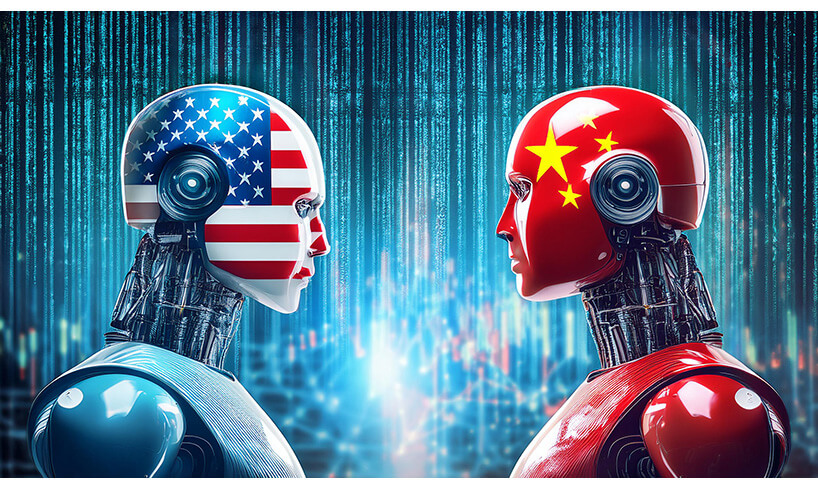
DeepSeek reduced inference costs by an estimated 90% to 95% through architectural innovations that dramatically improved compute efficiency. More recently, Moonshot AI’s Kimi K3 demonstrated that frontier-level performance can be achieved with significantly greater compute efficiency.
The implications are significant. If frontier AI can increasingly be delivered through more efficient architectures rather than larger compute clusters, competitive advantage may shift from those with the largest infrastructure budgets to those with the most efficient models. That would challenge one of the central assumptions underpinning today’s AI investment cycle.
Conclusion: Rebalancing the AI Pyramid
The AI boom is unlikely to end, but its economics are being redefined. The long-term winners may not be those building the largest models or investing the most capital, but those that convert compute into sustainable economic value.
Like a Dahi Handi pyramid, the AI economy depends on every layer performing its role. Yet as the industry matures, competitive advantage will shift from scale alone to efficiency. In the race to build the future of AI, the winners may not be those that climb the highest, but those that build the most resilient pyramid.
“AI is an industrial bubble, not a financial bubble. Investors may lose money, but when the dust settles, we still get the inventions.”
– Jeff Bezos
Vedant Kale is an independent strategist, writer, and founder of Vedant Insights. He writes at the intersection of geopolitics, economics, and technology.
Follow on LinkedIn | Visit csuitemodels.com | Subscribe to Vedant Insights
 VEDANT INSIGHTS