NVIDIA sells the picks and shovels of the AI boom. Increasingly, it owns stakes in the gold mines too.
The California Gold Rush made very few miners rich. The real fortunes went to the merchants who sold them shovels, denim and flour.
Nearly two centuries later, the AI boom is following the same script. Hyperscalers and frontier labs are racing to strike gold, and NVIDIA is selling them the picks and shovels: the chips, servers and networking gear that every AI data center runs on.
NVIDIA was founded in 1993 to make graphics chips for video games. Three decades later, it is the barometer of the US stock market. Worth more than $5 trillion, it is the most valuable company in the world, larger than the annual GDP and the value of the entire stock market of most countries.
What NVIDIA sells today
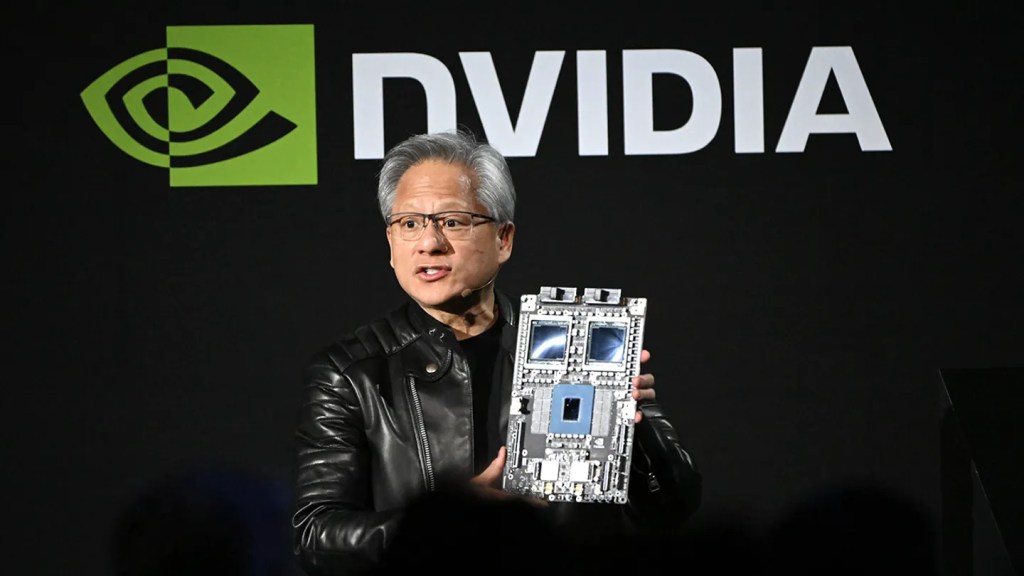
NVIDIA today sits at the epicenter of the AI world. The video game chips are still there, but they are now a side business. In the quarter ending July 2026, NVIDIA earned $96.2 billion in revenue, and $89.0 billion of it came from data centers, the vast warehouses of computers where AI models are trained and run.
The chip. NVIDIA’s graphics processing units, or GPUs, were built to draw millions of pixels at once. That ability to run many calculations in parallel turned out to be exactly what AI needs. Its Blackwell and new Vera Rubin chips are the most sought-after in the world.
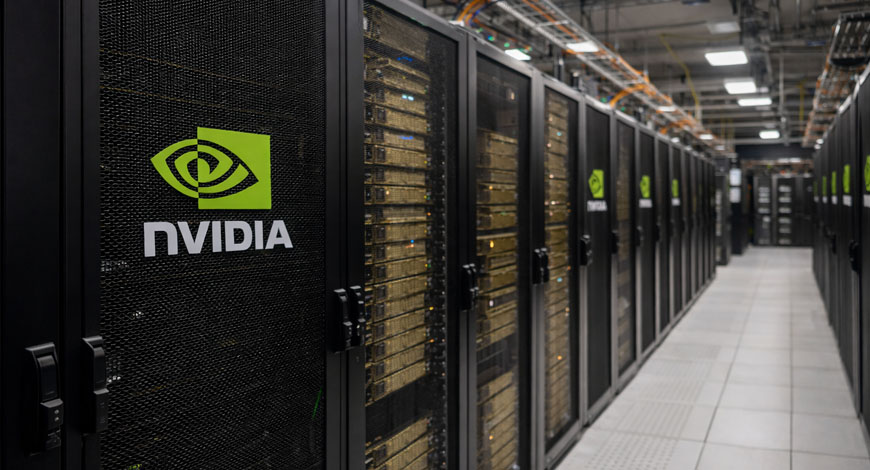
The system. NVIDIA sells entire server racks, packed with GPUs and its own processors, ready to plug in and run.
The network. Training a large model requires tens of thousands of GPUs to behave as a single machine. NVIDIA makes the links and switches that connect them, a business now worth more than $14 billion a quarter.
The software. CUDA, NVIDIA’s programming platform, has been the default tool for AI developers for nearly two decades. That makes switching to a rival chip slow and costly.
NVIDIA does not just sell shovels. It sells the entire mining operation, each part engineered to work best with the others. That is vertical integration as a moat. Every layer a customer buys raises the cost of leaving, and every layer NVIDIA controls captures more of each dollar spent on AI.
The supply chain behind the shovels
NVIDIA is a fabless chip designer and outsources semiconductor manufacturing.
TSMC manufactures nearly all of NVIDIA’s chips and packages them using CoWoS, an advanced technique that places the GPU and its memory side by side on a single base. CoWoS capacity has been the biggest bottleneck of the AI boom. The relationship has reshaped TSMC too. In 2025, NVIDIA overtook Apple as its largest customer, accounting for about 19% of revenue, a share analysts expect to reach about 22% in 2026.
SK Hynix, Samsung and Micron supply high-bandwidth memory, or HBM, the ultra-fast memory every AI chip needs. SK Hynix sold out its entire 2026 supply in advance.
Foxconn, Quanta and Wistron assemble the chips into finished server racks.
Corning provides the optical fiber that connects those racks at scale. NVIDIA has committed up to $3.2 billion to Corning to secure that supply.
This asset-light model is a big reason for NVIDIA’s exceptional margins. But it also concentrates risk. Most of the world’s AI compute passes through a handful of factories in one corner of Asia.
NVIDIA’s competitive advantage extends beyond chip design. Its scale, supplier relationships and long-term manufacturing commitments help it secure capacity in a supply-constrained market. As of July 26, 2026, NVIDIA had $279 billion in supply and capacity commitments, reflecting the scale of its plans to meet future demand. These commitments are obligations, not cash already spent.
In a gold rush, whoever controls the shovel factory controls the rush.
Who is buying the shovels
Every dollar NVIDIA earns is a dollar someone else has decided to spend.
The biggest buyers are the hyperscalers, the cloud giants that rent computing power to the rest of the world. Amazon, Microsoft, Alphabet and Meta together plan to spend about $725 billion on capital expenditure in 2026, up 77% in a single year. Analysts expect the figure to pass $1 trillion in 2027. These companies and their peers account for roughly half of NVIDIA’s data center revenue.
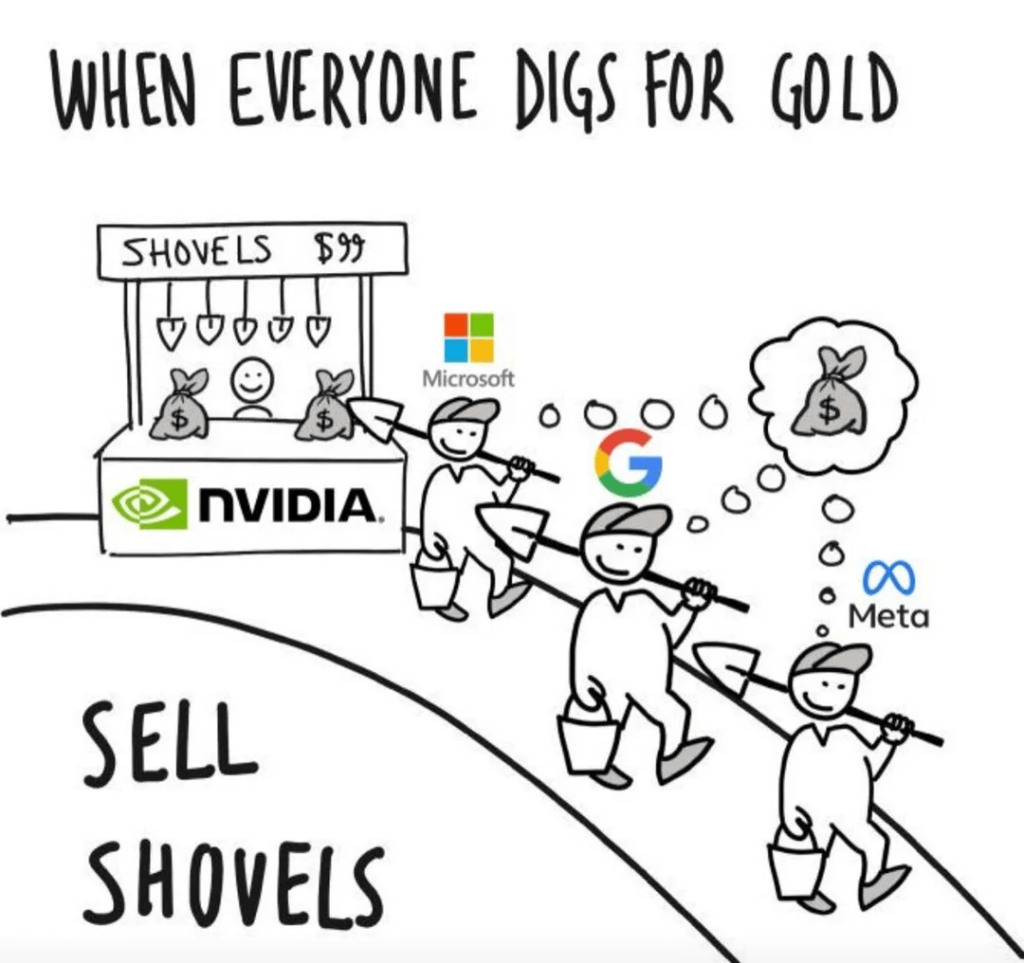
Behind the cloud giants come the frontier AI labs, and none is hungrier than OpenAI. Its demand for computing power is large enough to shape the market on its own.
For NVIDIA, OpenAI is both a customer and an investment. In early 2026, NVIDIA took a $30 billion stake in the company, and much of that money is expected to return as orders for its chips. Economists call this vendor financing: a supplier funds its customer so the customer can keep buying. It accelerates demand in good times and amplifies losses when the customer stumbles. The shovel seller is now funding the miner who buys its shovels.
The business model of NVIDIA
NVIDIA’s business model rests on two facts: its products are extraordinarily expensive, and they age extraordinarily fast. In its latest quarter, NVIDIA generated a gross margin of 75%. Its GAAP net margin was approximately 62%, although that figure included substantial gains from equity investments. On a non-GAAP basis, its net margin was approximately 56%.
NVIDIA sells AI computers at two scales. A single server with eight of its latest Blackwell GPUs costs roughly $400,000 to $550,000. A full rack of 72 GPUs, wired into a single system, costs about $5 million, and its successor, the Vera Rubin rack, is estimated at nearly $8 million. A large AI data center holds thousands of these racks.
At that scale, the numbers become staggering. Jensen Huang puts the cost of a one-gigawatt AI campus at $50 to $60 billion. Barclays estimates that 65% to 70% of that budget goes to compute and networking, roughly $33 to $42 billion per gigawatt, and most of it flows to NVIDIA.
Then the clock starts. NVIDIA now launches a new generation every year, and each delivers far more computing power per dollar than the last. A customer running last year’s racks pays more per AI answer than a rival on the newest hardware. Falling behind one generation is a competitive disadvantage. Falling behind two can be fatal.
The resale market tells the same story. A $500,000 server bought today may be worth less than half that within three years, even though the hyperscalers spread its cost over five to six years on their books.
This is the quiet genius of NVIDIA’s model. It sells hardware, but the annual upgrade cycle makes it behave like a subscription. For customers competing at the frontier of AI, frequent hardware upgrades can become a strategic necessity, even though older systems remain useful for less demanding workloads.
Cracks in the mine
NVIDIA’s dominance is not guaranteed. Its biggest customers are building alternatives: Google now sells its TPU chips to outside buyers, and Anthropic and Meta have both signed major deals for them. China, once about 13% of NVIDIA’s revenue, is now largely closed off by export controls. And the real limit may be power, not chips. Analysts expect 30% to 50% of the data center capacity planned for 2026 to slip to 2028 for lack of grid connections. A GPU without electricity is just inventory.
Still, none of these threats looks strong enough to dethrone NVIDIA today. NVIDIA will rule this decade.
Building the AI economy, one bet at a time
The gold rush merchants sold their shovels and moved on. NVIDIA is doing something far more ambitious. Since the start of 2025, it has joined more than 100 startup funding rounds, and its stakes in private companies were worth $43 billion by May 2026.
Look at where that money goes, and the vision becomes clear. NVIDIA backs the companies building the models, including OpenAI, Anthropic, xAI and Mistral. It backs the tools developers use every day, such as Cursor and Perplexity. And it backs the frontiers where AI moves into the physical world: robots at Figure AI and Skild AI, drug discovery at Proxima, new materials at CuspAI and quantum computing at PsiQuantum.
Each bet expands the market for NVIDIA’s chips. Every robot, every drug model and every new lab will need computing power, and most of it will run on NVIDIA hardware. The company is not just supplying the AI economy. It is helping to build it, sector by sector.
The picks-and-shovels story is still true. But today, wherever anyone strikes gold, a share of it belongs to NVIDIA.
Rockefeller controlled the oil that fueled the Industrial Revolution.
– Vedant Kale
NVIDIA controls the compute that powers the AI revolution.

